The envelope method: the simplest way to control variable spending
With the envelope method, each spending category has an envelope with a set amount, and when it is empty that category is done for the month. Read about the classic and digital versions, an example and practical tips.
In this article
Fixed costs such as rent and instalments rarely cause problems; their amounts are known and repeat every month. What breaks a budget is variable spending: groceries, restaurants, transport, small purchases and fun. The envelope method is one of the oldest and simplest ways to tame these costs, and for many families it still works better than any complex spreadsheet.
What is the envelope method?
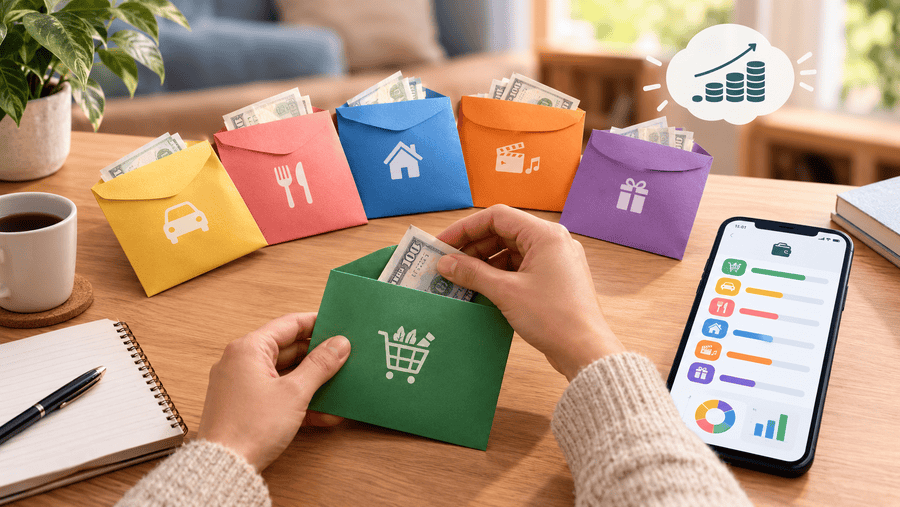
In the classic version, you put cash into several envelopes at the start of the month: one labelled food, another transport, a third fun and so on. Each expense is paid only from its own envelope. When an envelope is empty, spending in that category is over for the rest of the month, unless you consciously move money from another envelope.
Why does it work?
- The limit is tangible: watching an envelope get lighter has far more effect than a number on a screen.
- Every expense is a choice: when a category's money is limited, you have to choose between options.
- No complex maths: the balance in each envelope is exactly what is left for that category.
- Small purchases become visible: scattered little purchases that get lost in a bank account are taken from an envelope and noticed.
Which costs need an envelope?
Envelopes are for variable spending, not fixed costs. Pay rent, instalments and bills directly and use envelopes for categories whose amount depends on your behaviour. Five to seven envelopes are enough to start; too many make it hard to manage.
How do you set each envelope's amount?
Instead of guessing, look at your actual spending over the last three months. Calculate each category's average and, if you want to save, take ten percent off. Limits far below reality break in the first week and kill motivation.
A worked example
Suppose that after fixed costs and savings, 10 million toman is left for the month's variable spending:
| Envelope | Monthly amount (toman) | Note |
|---|---|---|
| Groceries and food | 4,200,000 | Split into four weekly envelopes |
| Transport and fuel | 1,600,000 | Includes taxis and fares |
| Restaurants and cafes | 1,200,000 | Biggest temptation, smallest limit |
| Home and cleaning | 800,000 | Detergents and supplies |
| Fun and leisure | 1,200,000 | Cinema, games and outings |
| Unexpected costs | 1,000,000 | Buffer for the other envelopes |
Splitting the food envelope into four weekly envelopes is a key trick: if you overspend in the first week, only that week is under pressure and the whole month is not at risk.
The digital envelope method
Today most payments are by card and carrying cash is not always practical. The digital version applies the same logic with modern tools:
- Create a spending category for each envelope.
- Write each envelope's amount into the month's budget.
- Record every expense immediately under the right category.
- Every few days compare each category's spending with its envelope.
Some people use a separate card with a limited balance for risky categories such as restaurants, so they really feel the envelope's limit.
When an envelope runs out early
It happens, and that is fine. Follow two simple rules: first, only move money from other variable envelopes and never take it from savings. Second, record the move so you can set a more realistic amount next month. An envelope that empties early every month was probably too small from the start.
What to do with leftover money
If money is left in an envelope at the end of the month, move it to savings or a specific goal. This rewards frugality and makes you more motivated to stick to the envelopes next month.
Frequently asked questions
Does the envelope method suit large families?
Yes, even more so, because everyone knows what is left in each category and decisions become more transparent. The envelopes just need to be shared and the balances easy to see.
Do I need a separate envelope for every small cost?
No. Combine small categories into one miscellaneous envelope. The goal is to simplify, not complicate.
Summary
The envelope method rests on one simple rule: each spending category has its own limit. With cash or digitally, it makes variable spending visible and controllable. In Polamo, create a category for each envelope and record expenses under it; the analytics charts show how much of each envelope has been spent.